
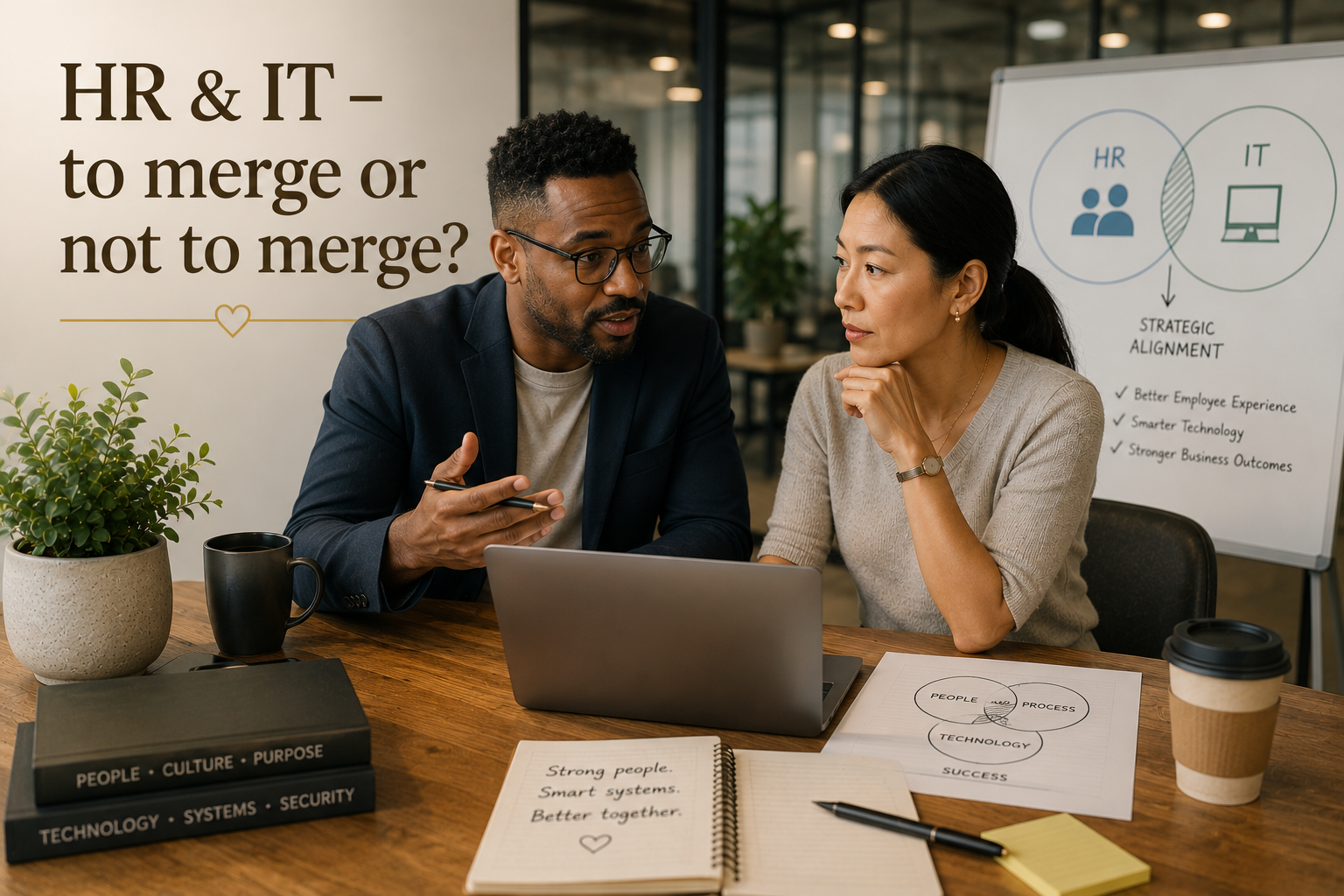
Artificial intelligence is changing the way businesses operate at a pace few could have imagined even a few years ago. From recruitment and employee onboarding to cybersecurity, predictive analytics, automation, and decision support, AI is reshaping virtually every business function. As organizations continue to embrace digital transformation, a new question has emerged.
Should Human Resources and Information Technology remain separate departments, or is it time to merge them under one leadership structure? As a former HR executive, I have found myself reflecting on this question. I understand why organizations are beginning to explore the idea. AI is bridging gaps that once existed between departments, enabling faster access to information, streamlining workflows, and creating opportunities for greater collaboration. Yet I also find myself asking whether merging HR and IT is the right solution—or whether strengthening collaboration between the two functions may ultimately prove more effective.
Two Very Different Disciplines
Traditionally, HR and IT have served very different purposes within an organization.
Human Resources focuses on people. Its responsibilities include talent acquisition, leadership development, organizational culture, employee engagement, performance management, learning and development, succession planning, workplace wellbeing, employee relations, and helping organizations create environments where people can thrive.
Information Technology, on the other hand, focuses on technology. Its priorities include infrastructure, cybersecurity, software development, digital systems, data management, cloud computing, business continuity, technical support, automation, and enabling employees to work effectively through technology.
While both departments support the organization, they do so from fundamentally different perspectives.
- HR asks, “How do we help people succeed?”
- IT asks, “How do we enable the business through technology?”
Historically, these functions have required different technical expertise, different professional qualifications, and different ways of thinking.
The AI Bridge
Artificial intelligence is beginning to change that relationship. AI has become the bridge connecting people, technology, and business strategy in ways we have never seen before. Today’s HR professionals are increasingly using AI to streamline recruitment, analyze workforce data, personalize learning, improve employee experiences, and automate repetitive administrative tasks. At the same time, IT teams are implementing, securing, governing, and maintaining the technologies that make these capabilities possible. Neither department can succeed independently.
- HR needs technology.
- IT needs an understanding of how people interact with technology.
As AI becomes more deeply embedded in business operations, collaboration between these two functions becomes essential.
AI Is Powerful, But It Is Not Human
There is no doubt that AI is one of the most significant technological advances of our time. It can analyze enormous amounts of information within seconds, recognize patterns, translate languages, generate content, summarize documents, make recommendations, and support decision-making in ways that were unimaginable only a few years ago. However, AI should still be viewed as a tool rather than a replacement for human judgment. Even leading AI platforms acknowledge that important information should be verified because errors can occur. AI can process information remarkably well, but it does not possess human consciousness, emotional intelligence, lived experience, ethical reasoning, or genuine empathy.
- It can simulate aspects of human thinking.
- It cannot replace the human mind.
This distinction is particularly important in Human Resources, where decisions often involve complex interpersonal situations, ethical considerations, organizational culture, and emotional intelligence. Technology can support these decisions. It should not make them in isolation.
Why Some Organizations Are Merging HR and IT
Several organizations have already begun experimenting with combining HR and IT under a single executive leader. The thinking behind this approach is understandable. Technology is no longer simply supporting the workforce—it is becoming part of the employee experience itself. From recruitment platforms and learning management systems to collaboration tools, AI assistants, workforce analytics, and digital workplaces, technology now influences almost every stage of the employee lifecycle. Some business leaders argue that having one executive responsible for both people and technology creates greater alignment, faster decision-making, improved investment priorities, and a more seamless employee experience. Rather than managing technology separately from people, they believe organizations should integrate the two into one strategic vision. It is certainly an interesting proposition.
The Potential Risks
Yet there are also legitimate concerns.
- HR and IT are highly specialized professions.
- An exceptional HR leader may not possess deep technical expertise in cybersecurity, enterprise architecture, software implementation, or cloud infrastructure.
- Likewise, an outstanding technology executive may not have the experience required to navigate complex employee relations, organizational psychology, labor legislation, leadership development, or workplace culture.
- Every discipline has its own body of knowledge.
- One potential risk of merging departments is that specialist expertise becomes diluted.
- Organizations may unintentionally weaken the very capabilities that have traditionally made each function successful.
Perhaps the question is not whether HR and IT should merge.
Perhaps the better question is whether they should collaborate far more closely than they have in the past.
Collaboration May Be the Better Model
In many organizations, HR and IT have always worked together successfully while maintaining separate leadership structures. Technology initiatives often require HR’s understanding of people, while HR initiatives increasingly depend on technology to achieve meaningful outcomes. Rather than eliminating the boundaries between the two disciplines, organizations may benefit from creating stronger partnerships built on shared goals, regular collaboration, and cross-functional teams.
AI implementation is a perfect example. Successful AI adoption requires technical expertise, governance, cybersecurity, change management, workforce planning, employee communication, learning, and ethical oversight. No single department possesses all of these capabilities. Success depends on collaboration.
What About Jobs?
One of the greatest concerns surrounding AI is its potential impact on employment. Automation will undoubtedly change the nature of many jobs, and some roles will disappear over time. However, history has consistently shown that technological revolutions also create entirely new opportunities. Many organizations embracing AI are not simply reducing headcount—they are redesigning work. As repetitive tasks become automated, new roles are emerging in AI governance, data management, prompt engineering, digital ethics, human-centered design, change management, cybersecurity, workforce analytics, and organizational transformation.
The future workforce will look different. The most valuable employees will likely be those who remain adaptable, continuously develop new skills, and embrace lifelong learning. AI is unlikely to replace people. More accurately, people who know how to work effectively with AI may increasingly replace those who choose not to.
Preparing for the Future
Every organization should already be thinking strategically about AI. This is not solely an IT initiative, nor is it exclusively an HR responsibility. It is a business transformation initiative. Organizations would be wise to establish cross-functional teams that assess where AI can add value, identify potential risks, establish governance frameworks, develop employee capabilities, and ensure technology is implemented ethically and responsibly. The conversation should never be about replacing people. It should be about enabling people to do their best work.
Final Thoughts
After considering the research and reflecting on my own experience, I can certainly see HR and IT working more closely together than ever before. Whether that ultimately means merging the two departments will depend on each organization’s size, strategy, culture, and leadership capability. Personally, I believe collaboration offers greater long-term value than consolidation. HR and IT are distinct disciplines with different expertise, different priorities, and different professional identities. Both deserve strong specialist leadership.
What is undeniable, however, is that AI has become the bridge connecting these two worlds. As business continue to evolve, the organizations that succeed will not simply adopt new technologies, they will learn how to bring people and technology together in ways that create healthier workplaces, stronger businesses, and a more sustainable future.
Source: BBC News, Why firms are merging HR and IT departments, Sean McManus, Technology Reporter
